
Article Summary:
The kVA rating of a محول من النوع الجاف is one of the most important parameters in the design of electrical systems. This affects the safety, efficiency, load capacity, and long-term reliability of the system.
Authenticate references like IEC 60076 (power transformers), IEEE C57 standards, and Electrical Power Systems by C.L. Wadhwa’s rating, which is the kilovolt-ampere (kVA) value, describes the maximum apparent power a transformer can sustainably operate under the specified conditions without exceeding its thermal limits.
This article provides a comprehensive, industry-oriented description of what the kVA rating means for a dry-type transformer, how it’s calculated, the different standards that exist, and how engineers, contractors, and procurement personnel should choose the appropriate kVA rating for real-world applications.
Introduction: Why the kVA Rating of a Dry Type Transformer Matters
Today, modern power distribution systems typically have a dry-type transformer that’s increasingly popular in commercial buildings, industrial facilities, renewable energy sources, and infrastructure projects. Their oil-free design, reduced risk of fire, and lower environmental impact make them ideal for interior and safety-conscious uses.
However, choosing a dry-type transformer that is not fully familiar with its kVA capacity can lead to serious consequences, including overheating, voltage instability, early insulation failure, and costly downtime. The kVA rating is not simply a numerical value on a nameplate- it represents the true capacity of the transformer in terms of electrical and thermal energy.
This article addresses a fundamental question that is often misunderstood: What is the kVA value of a dry-type transformer, and how should it be applied in practice?
ما هو المحول من النوع الجاف؟
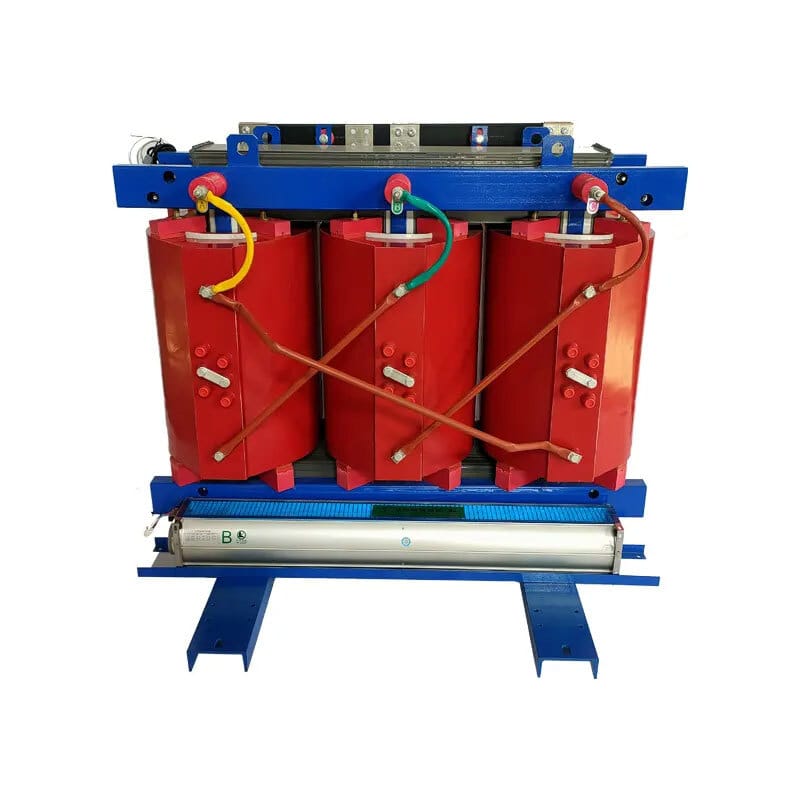
A dry-type transformer is an electrical transformer that employs air or solid insulation systems instead of liquid insulation oil for protection from heat and to strengthen the dielectric.
The most important attributes of dry transformers are
No insulating substance or liquid that cools the chip.
Air-conditioned (AN or AF)
Lower probability of fire and explosion.
Advantages include its portability and efficiency in small and confined spaces.
Low environmental risk of contamination
Dry-type transformers are typically employed in:
Business buildings
Hospitals and information centers
Plant manufacturing
Alternative energy sources
Alluvial and other installations in the marine and offshore areas.
Understanding kVA Rating: The Basics
What is the meaning of kVA?
kVA advocates the use of kilovolt-ampere, a unit of apparent power in an AC electric system.
kVA: The voltage (V) and current (A) of a 1000-watt power source are considered.
Unlike the actual power level, kVA doesn’t take into account the power factor. Transformers are measured in kVA because their heating is based on voltage and current, not on the load’s power factor.
What is the kVA Rating of a dry-type transformer?
The kVA rating of a dry-type transformer is the maximum apparent power that can be provided continuously at the same voltage and frequency while not exceeding the maximum temperature rise.
Key Points About the kVA Rating System
Decided by the thermal design and class of insulation
Separate power source
Under normal conditions, it applies.
International standards define the term.
The kVA rating is always listed on the transformer nameplate and in the manufacturer’s datasheet.
Standard kVA Ratings of Dry Type Transformers
Dry-type transformers are manufactured in standard kVA sizes to simplify system design and interchangeability.
Common Standard kVA Ratings
| Low Voltage & Distribution Range | Medium Power Range | High Power Range |
| 5 kVA | 300 kVA | 2000 kVA |
| 10 kVA | 500 kVA | 2500 kVA |
| 15 kVA | 750 kVA | 3000 kVA |
| 30 kVA | 1000 kVA | 4000 kVA |
| 50 kVA | 1500 kVA | 5000 kVA |
In practice, most dry type transformers are rated from 5 kVA up to 5000 kVA, with higher ratings available for special industrial or utility applications.
How the kVA Rating of a Dry Type Transformer Is Determined?
- Thermal Design Limits
The primary factor governing kVA rating is heat dissipation.
Copper losses (I²R losses)
Core losses (hysteresis and eddy currents)
درجة الحرارة المحيطة
Cooling method (AN vs AF)
- فئة العزل
Dry-type transformers are classified by insulation temperature limits:
| فئة العزل | Max Temperature (°C) |
| Class A | 105 |
| Class B | 130 |
| Class F | 155 |
| Class H | 180 |
Higher insulation classes allow higher kVA ratings for the same physical size.
Cooling Methods and Their Impact on kVA Rating
Transformers that don’t require air for heat dissipation are called dry. The method of cooling directly affects the capacity for continuous operation and the thermal margin.
- Common Cooling Methods
AN (هواء طبيعي)
Natural convection, no assistance needed
Lower the kVA rating for every physical measurement
Increased temperature on the load.
Common for both small and medium-sized films
Impact on KVA
Constant kVA rating
Capacity for limited overload
AF (Air Force)
Fans facilitate the flow of air.
Increases the efficiency of cooling by 30-50%.
Impact on KVA
The same transformer can facilitate a higher kVA in the AF mode.
Example:
1,000 kVA (AN)
1400-1500 kVA (AF)
Design Notation
The rating ofAF is typically limited to short-term or occasional loading, unless otherwise stated.
- Contrasting the behavior of Castor and VPI’s Cooling System.
Converters that contain resin have a greater capacity to handle thermal cycling.
VPI units (Vacuum Pressure Impregnated) have a higher degree of dissipation of heat but are more susceptible to contamination.
Load Characteristics and kVA Selection
The kVA must take into account the current popularity, not just the real power.
Key Load Schedules
- Constant Loads
Resistant heaters
Incandescent lighting
Effect
Constant current
kVA is the same as kW, but with a different power factor.
- Non-linear-Tension Loads
VFDs
Rectifiers
UPS systems
LED controllers
Effect
Harmonic currents increase the average current.
The transformer must be enlarged (typically 125%-150%)
Design Advice
Use K-factor-rated dry-type transformers for high-frequency environments.
- Motor Loaf’s
Elevated startup current.
Repeated starts lead to increased thermal stress.
kVA consideration
The transformer must have the ability to start a current without a lot of voltage loss.
Harmonics and kVA Derating
Harmonics increase winding losses and core heating.
Typical Derating Guidelines
| Total Harmonic Distortion (THD) | Recommended Derating |
| < 5% | No derating |
| 5–10% | 5–10% |
| 10–20% | 15–25% |
| > 20% | 30% or more |
For harmonic-rich environments, K-rated dry-type transformers are often specified.
Ambient Temperature and Altitude Effects
- Temperature of the ambient
Many dry-type transformers are capable of handling:
40°C maximum temperature allowed in the ambient
Temperature average of 30°C over the course of 24 hours.
Higher Temperature in the ambient:
Reduces the heat of dissipation
Require kVA’s derating or enhanced insulation class.
Common Rule
For every 10 degrees Celsius above 40 degrees Celsius, decrease the kVA by around 10%.
- Altitude Effects
Higher elevations:
The concentration of air decreases.
The efficiency of cooling is decreased
Common Derating Guidelines
| الارتفاع | Typical kVA Derating |
| ≤1000 m | No derating |
| 1000–2000 m | 5–10% |
| 2000–3000 m | 10–15% |
| >3000 m | Custom design required |
kVA Rating vs kW Requirement
A common mistake is confusing kVA and kW.
kVA=kW/Power Factor
Example:
Load = 800 kW
Power factor = 0.8
Required transformer = 1000 kVA
The dry-type transformer kVA rating must always be higher than the calculated load kVA.
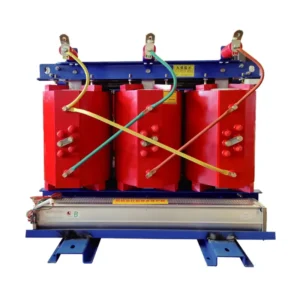
Comparison: Dry Type vs Oil-Immersed Transformer kVA Ratings
| الميزة | محول من النوع الجاف | محول مغمور بالزيت |
| Max typical kVA | Up to 5000 kVA | Exceeds 100 MVA |
| Cooling efficiency | أقل | أعلى |
| مخاطر الحرائق | منخفضة جداً | أعلى |
| Indoor use | Ideal | Restricted |
| الصيانة | منخفضة | معتدل |
Industry Applications and Typical kVA Ranges
Transformers that are dry have a wide range of applications. The required kVAh depends on the load’s type, duty cycle, and environmental conditions.
- Businesses and other organizations that require large amounts of space for their operations
التطبيقات
Office buildings
Mall shopping
Hotels
Airports
Typical kV range
100 kVA – 2500 kVA
Key Ideas
Large amount of HVAC and lighting loads
Increasing the frequency of VFDs → Harmonic compensation necessary
- Industrial and manufacturing facilities
التطبيقات
Production sequences
Extrusion and molding devices
Compressors and pumps
Typical kV range
250 to 5,000 kVA
Key Ideas
The starting currents for the motor.
Occasional maximum loads
Frequent insulation and AF temperature control were both necessary.
- Healthcare and Pharmaceutical Benefits
التطبيقات
Hospitals
Clean spaces
Diagnostic tools
Typical kV range
100 kVA – 3000 kVA
Key Ideas
Low sound
High dependability
Safety and backup
- Data Centers and IT Infrastructure
التطبيقات
Server spaces
Data centers at the edge
UPS systems
Typical kV range
500 kVAh – 4000 kVAh
Key Ideas
Non-linear-weighted loads
Elevated currents with a high frequency
The K-factor recommends dry-type transformers that are rated.
- Alternative Energies and Utilities
التطبيقات
Solar-powered inverter stations
Auxiliary power systems based on wind power.
Energy storage devices (ESD)
Typical kV range
250 to 3500 kVA
Key Ideas
Changing loads
High temperatures in the ambient environment
Violation of grid regulations
How to Choose the Right kVA Rating of a Dry Type Transformer?
Choosing the correct kVA rating requires a system-level approach, not just matching connected load power.
Step 1: Calculate Total Load Demand
kVA=kW/Power Factor
Example
Total load: 720 kW
Power factor: 0.9
Required kVA = 800 kVA
Step 2: Evaluate Load Characteristics
| Load Type | Impact on kVA |
| Linear loads | Standard sizing |
| Motors | Add margin for starting current |
| VFDs / UPS | Oversized by 25–50% |
| Harmonic loads | Use a K-factor transformer |
Step 3: Think About the Cooling Method
AN (Air Natural) → Constant measurement
AF (Air Force) → More frequent kVA’s
Best Practice
Select kVA’s based on the AN rating that would allow for continuous operation.
Step 4: Utilize Environmental Decreasing
Temperature above 40°C in the ambient environment.
Elevation above 1000 meters
Result
Increase the kVA or request a discounted design
Step 5: Allow for Future Advancement
Typical allowance: 15-25 percent extra capacity
Avoid operating at a load of over 80-85%.
Regulatory Standards Governing kVA Ratings
The dry type power ratings must follow international and regional regulations in order to ensure safety, efficiency, and communication between devices.
IEC Rules
IEC 60076 series – Power transformers
IEC 60076-11 — dry Transformers.
Discusses the rating system of kVA.
Temperature increase restrictions
Insulation levels (F, H)
Cooling methods (AN, AF)
Common IEC kVAs of the Commonratings
100, 160, 250, 400,630, 800, 1000, 1600, 2000, 2500 kVA
IEEE/ANSI specifications
IEEE C57.12.01 – Allgemeine Variablen
IEEE C57.12.91 – Test procedure for dry-type transformers.
IEEE C57.110 – Constant frequency and voltage loadings
التركيز
Temperature performance
Harmonic voltage impact
Constant capacity to load
The UL and CSA certifications
UL 1561 – General-purpose dry transformers
UL 1562 – Power transformers
CSA C9 – The Canadian standard
Importance
North American markets must have it.
Frequently necessary for insurance and building permits
Energy Efficiency Rules
DOE 2016/ 2023 (U.S.)
EU Ecodesign (law 1474/2014)
Impact
The minimum efficiency levels are associated with the kVA rating.
The influence of the core material and the loss.
Common Mistakes at the KVA Rating Scale
Selecting non-standard voltage ratings that are not recognized by IEC/IEEE.
Violating the harmonious scheduling rule
Using the AF score as a continuous measurement
Ignoring local regulations (UL / CSA / CE)
Future Trends in Dry Type Transformer kVA Design
Higher efficiency core materials
Advanced resin insulation
Compact high-kVA designs
Smart thermal monitoring
These innovations allow higher kVA density without compromising safety.
FAQ: kVA Rating of a Dry Type Transformer
- What is the typical voltage range of a dry-type transformer?
Many dry-type transformers have a capacity of 5 kVA to 5000 kVA, depending on the application.
- Can a basic transformer with a dry type handle an overload that exceeds its kVA capacity?
Overload periods of short duration are possible, but operation at a higher than recommended kVA is not recommended continuously.
- Does the power factor affect the kVA capacity of a dry-type transformer?
No. The kVA rating is unaffected by the power factor.
- How does forced air conditioning influence the kVA rating?
Forced air conditioning can increase the maximum amount of kVA that can be used by as much as 40%.
- Should I make the transformer larger than life?
Moderate undersizing is beneficial for future growth and dependability.
Conclusion: Understanding the kVA Rating of a Dry Type Transformer
The kVA rating of a dry-type transformer is a fundamental attribute that describes its electrical capacity, thermal properties, and appropriateness for a specific purpose. Beyond the simple nameplate value, it demonstrates the insulation design, method of cooling, behavior of loads, and environmental attributes.
For professionals in the engineering and professional fields, choosing the appropriate kVA rating is about balancing safety, efficiency, cost, and future potential. By understanding the process of determining and applying the KVA rating in real-world systems, decision makers can avoid common mistakes and ensure long-term operational stability.

 Arabic
  English
  Russian
  French
  German
  Spanish